Below is the calendar for the upcoming YESC year for our branch at the Upper Main Line Y! Click each event on the calendar for times, descriptions, prices, and other important information. Please take note of the meeting location!! To view this calendar in list form, select "Agenda" view on the top right corner of the calendar. Prior to registration, please review the Policies blog post listed below. Please register for these programs through the Welcome Center at the Upper Main Line YMCA by phone at 610-647-9622.
Friday, August 16, 2013

Lionville YESC Calendar
Hey gang,
Below is the calendar for the upcoming YESC year for our branch at the Lionville Y! Click each event on the calendar for times, descriptions, prices, and other important information. Please take note of the meeting location!! To view this calendar in list form, select "Agenda" view on the top right corner of the calendar. Prior to registration, please review the Policies blog post listed below. Please register for these programs through the Welcome Center at the Upper Main Line YMCA by phone at 610-647-9622.
YESC Policies for 2013-2014
YEAR-ROUND POLICIES
- If you would like to register for a YESC trip, please do so by calling the Welcome Center at 610-647-9622.
- Signups for trips close 72 hours before the departure of a trip. Participants must be registered before this time. For a Saturday day trip of 12 hours or less in length, participants must be registered by 9:00 PM the Wednesday before!
- To withdraw from a trip, call the Welcome Center directly. Do not email YESC! Participants who withdraw within 72 hours of the departure of the trip will receive no refund. Exceptions will be made at the discretion of YESC staff.
- Participants must be registered for a trip before they arrive for departure.
- Participants must arrive on-time for a trip or event! YESC will wait for fifteen minutes for late participants before our departure. Please arrive five minutes before the scheduled trip time.
- Refunds and reimbursements for Expeditions will be handled on a case by case basis for each Expedition.
- Prior to a field trip or service projects participants must complete and submit the YESC Release Form. This form must be renewed every year. Please email yesc@umly.org to get a copy of the forms.
SUMMER POLICIES (June 17th - August 30th)
- There is a $25.00 YESC Summer Registration Fee (per child) that is due from anyone who signs up for any of the YESC Summer Programs. The $25.00 is due at the time of registration. It is non-transferrable, non-refundable.
- YESC Marine Ecology Expedition
- No Dates Determined at this Time: Expedition will be in month of August
- Follow Camp Rules/Policies (See Below)
- YESC Maine Expedition
- Dates: July 6th – July 13th
- Payment Schedule:
- March 1: $237.50
- April 1: $237.50
- May 1: $237.50
- June 1: $237.50
- Cancellation and Refund Policy:
- 100% Refund if you cancel prior to March 1st
- 50% Refund if you cancel prior to April 1st
- 25% Refund if you cancel prior to May 1st
- No Refunds after May 1st
- YESC Force of Nature
- Follow Camp Rules/Policies (See Below)
- Canoe Adventure
- Follow Camp Rules/Policies (See Below)
- Dates: July 29th – August 2nd
- Overnight
- Boot Camp and NIT II
- Follow Camp Rules/Policies (See Below)
- Dates: July 22nd – July 26th
- Full Day
- Career Exploration
- Follow Camp Rules/Policies (See Below)
- Dates: July 15th – July 19th
- Full Day Camp
CAMP UMLY POLICIES
- Any changes to your original camp registration must be made in writing on a Camp Change form.
- Forms are available in the Welcome Center and Camp Office.
- Changes will not be accepted over the phone.
- All changes excluding additions should be made 14 days prior to the start of the requested camp session to avoid a $50 processing fee.
- All camp fees are due by May 15, 2013
- You can pay by Electronic Funds Transfer (EFT)
- Camp enrollment is not guaranteed until payment is received in full.
- If payment in full is not made two weeks prior to the start of the camp, the camper may be withdrawn from camp and his/her spot forfeited.
Wednesday, July 10, 2013
YESC Maine Expedition 2013 - Day 5 & VIDEO
3:15am came very quickly this morning as I rose to wake the crew for our drive to the top of Cadillac Mountain. Before I began the group wake up, I took a peek outside to see the beautiful night sky, but instead, was greeted with extensive cloud coverage. After conferring with Emma, we decided to push our Cadillac Mountain sunrise to another day.
Good thing! The cloud coverage remained all day, and heavy fogs moved in throughout the day. With the cloud coverage and colder temperatures, we knew we needed to bundle up extra for our whale watch and puffin tour!
We boarded the Atlanticat at the Bar Harbor Whale Watch Tour and, after a warning that the limited visibility would impede our ability to see whales, other travelers left the boat for refunds. However, YESC stayed strong, bundled up, and departed at 8:30am sharp from the dock for Petit Manan National Wildlife Refuge. Petit Manan is an island 17 miles northeast from Bar Harbor, and the objective of our journey was to find nesting Atlantic Puffin.

 Atlantic Puffin in flight! We saw a large amount of puffins floating in the waters off Petit Manan, and some even flew right around our boat!
The seabirds certainly treated us well, but the visibility definitely impacted our ability to find whales. After much searching, we were finally treated to two Minke Whales swimming nearby the boat! In addition to the whales, we saw Harbor Seals, Harbor Porpoises, and Dolphins. Those mammals were all too quick for me to snap any photos, but the views were quite enjoyable!

In the video below, Shaelyn gives us an update while aboard the Atlanticat. You can almost feel the high winds:
Our eBird checklist from the tour is below. "X" means the species was observed, but a total number was not counted:
Bar Harbor - Whale Watch, Hancock, US-ME
Jul 10, 2013 8:30 AM - 12:15 PM
Protocol: Traveling
20.0 mile(s)
Comments: Estimated mileage. Traveled from Bar Harbor Whale Watch Tours Headquarters to Petit Manan to an unknown location in the ocean. Temperatures were very cold, winds were very high, and visibility was low due to fog. Checklist taken from the Upper Main Line YMCA Earth Service Corps Maine Expedition 2013 - www.umly.org/yesc
16 Species:
Great Shearwater 8
Wilson's Storm-Petrel 2
Northern Gannet 4
Double-crested Cormorant 2
Laughing Gull X
Herring Gull 3
Great Black-backed Gull X
Common Tern X
Arctic Tern X
Common Murre X
Razorbill X
Black Guillemot X
Atlantic Puffin X
Rock Pigeon 4
Song Sparrow 1
American Goldfinch 1
After the whale watch, we spent some time cleaning the cabin before heading into Bar Harbor to tour the town. What will tomorrow bring? Depends upon the weather (which is calling for 30% chance of scattered thunderstorms - who knows what that means!)
Looking forward to an awesome day tomorrow!
- BQ
Good thing! The cloud coverage remained all day, and heavy fogs moved in throughout the day. With the cloud coverage and colder temperatures, we knew we needed to bundle up extra for our whale watch and puffin tour!
We boarded the Atlanticat at the Bar Harbor Whale Watch Tour and, after a warning that the limited visibility would impede our ability to see whales, other travelers left the boat for refunds. However, YESC stayed strong, bundled up, and departed at 8:30am sharp from the dock for Petit Manan National Wildlife Refuge. Petit Manan is an island 17 miles northeast from Bar Harbor, and the objective of our journey was to find nesting Atlantic Puffin.
The gang just before departure!
We were handsomely rewarded for our perseverance! Not only did we get to see lots of Atlantic Puffin, we were treated to a variety of seabirds such as Great Shearwater, Arctic Tern, Razorbill, and Common Murre. These birds are only seen far out in the ocean so these are hard birds to find. Life birds for most of the group!
Atlantic Puffin in flight! We saw a large amount of puffins floating in the waters off Petit Manan, and some even flew right around our boat!
Great Shearwater doing what it does best - flying low to the water and "shearing" it with its wings!
The seabirds certainly treated us well, but the visibility definitely impacted our ability to find whales. After much searching, we were finally treated to two Minke Whales swimming nearby the boat! In addition to the whales, we saw Harbor Seals, Harbor Porpoises, and Dolphins. Those mammals were all too quick for me to snap any photos, but the views were quite enjoyable!
Connor, Harrison, Shaelyn, and Austin were the strong survivors of the group. They remained on the top deck of the ship for the majority of the cruise despite the arctic-seeming temperatures and winds!
Our eBird checklist from the tour is below. "X" means the species was observed, but a total number was not counted:
Bar Harbor - Whale Watch, Hancock, US-ME
Jul 10, 2013 8:30 AM - 12:15 PM
Protocol: Traveling
20.0 mile(s)
Comments: Estimated mileage. Traveled from Bar Harbor Whale Watch Tours Headquarters to Petit Manan to an unknown location in the ocean. Temperatures were very cold, winds were very high, and visibility was low due to fog. Checklist taken from the Upper Main Line YMCA Earth Service Corps Maine Expedition 2013 - www.umly.org/yesc
16 Species:
Great Shearwater 8
Wilson's Storm-Petrel 2
Northern Gannet 4
Double-crested Cormorant 2
Laughing Gull X
Herring Gull 3
Great Black-backed Gull X
Common Tern X
Arctic Tern X
Common Murre X
Razorbill X
Black Guillemot X
Atlantic Puffin X
Rock Pigeon 4
Song Sparrow 1
American Goldfinch 1
After the whale watch, we spent some time cleaning the cabin before heading into Bar Harbor to tour the town. What will tomorrow bring? Depends upon the weather (which is calling for 30% chance of scattered thunderstorms - who knows what that means!)
Looking forward to an awesome day tomorrow!
- BQ
Tuesday, July 9, 2013
YESC Maine Expedition 2013 - Day 4
Scholars will maintain that today, July 9th, 2013, was 100% Earth Service HARD Corps!
Day 4 of the 2013 Maine Expedition began with a wonderful morning bird walk. We ventured to a row of fields on Eagle Point Road and were treated to spectacular views of Bobolink and Savannah Sparrow.
The main objective of the day was to complete a hike known as "The Four Peaks," a 4.5 mile hike which offers breathtaking mountaintop views including a view from the second largest peak in the park, Sargent Mountain.

The hike began around 10am, and as we ventured past the trail head, we were greeted to the sounds of Swainson's Thrush and Red-Breasted Nuthatch. After some great sightings, we encountered serious elevation change for a very long time. We stopped for frequent breaks as we climbed, but the trip up to our first stop, Bald Peak, proved to be a difficult one. As we ascended up the mountain, the low-hanging clouds quickly enveloped the mountain top. Although we were not treated to a spectacular view, we enjoyed the cooling sensation of the fast-moving clouds furiously blowing over the mountain top.
 Austin with the disappearing Bald Peak

 The heavy cloud cover seriously reduced visibility at the Sargent Mountain summit. My camera had difficulty focusing on us! At least the flag is flying proudly in the background.
As we descended down the Maple Spring Trail, we all reminisced on how we strangely began to miss the uphill climb instead of the tedious downward scaling over rocks. The rest of our journey from Sargent Mountain's summit was downhill, but criss-crossing over streams and fallen trees was very difficult when going down. After an hour and a half of downhill movement, we finally arrived back at the van!
Well, four mountain tops over 4.5 miles with approximately 1,000 feet of elevation change? I'd say that is what Earth Service HARD Corps is all about! I think it's safe to say that this adventure is surpassed in difficulty only by the Pool of Jade hike on the 2004 and 2008 Colorado Expedition. Needless to say, today was an absolutely unforgettable day in YESC history.
Well, time for bed. We are waking up at 3:15am to watch the sunrise on Cadillac Mountain, the first sunrise in the United States.
More updates tomorrow!
- BQ
Day 4 of the 2013 Maine Expedition began with a wonderful morning bird walk. We ventured to a row of fields on Eagle Point Road and were treated to spectacular views of Bobolink and Savannah Sparrow.
The main objective of the day was to complete a hike known as "The Four Peaks," a 4.5 mile hike which offers breathtaking mountaintop views including a view from the second largest peak in the park, Sargent Mountain.
Our ambitious route is outlined in red
Austin with the disappearing Bald Peak
We paused atop Bald Peak for a considerable amount of time to rest up. Much of the group was very exhausted from the steep and treacherous trip up the mountain. While we were letting our legs rest, a pair of Common Ravens sounded off and flew past the group before disappearing into the cloudy abyss below.
Mountain top after mountain top proved to be even more grueling as we powered over rocks and fallen trees to each destination. Even though each mountain was higher than the next, there was still a considerable amount of descending that had to be done after each peak before the next. As Zach said, "These wouldn't be labeled as separate mountains if they just kept going up!"
We flew the YESC Flag on all four mountain peaks. Here, the flag is flown at Gilmore Peak at 1036 feet. Not pictured: The massive gorge behind the flag, unfortunately covered by clouds.
Our final stop was on Sargent Mountain at 1373 feet above sea level. This climb proved to be the most difficult as it was not only the steepest, but it came after three challenging climbs to the other peaks. The arrival was magnificent! The highest winds and heaviest cloud coverage made for a dramatic arrival.
The heavy cloud cover seriously reduced visibility at the Sargent Mountain summit. My camera had difficulty focusing on us! At least the flag is flying proudly in the background.As we descended down the Maple Spring Trail, we all reminisced on how we strangely began to miss the uphill climb instead of the tedious downward scaling over rocks. The rest of our journey from Sargent Mountain's summit was downhill, but criss-crossing over streams and fallen trees was very difficult when going down. After an hour and a half of downhill movement, we finally arrived back at the van!
Well, four mountain tops over 4.5 miles with approximately 1,000 feet of elevation change? I'd say that is what Earth Service HARD Corps is all about! I think it's safe to say that this adventure is surpassed in difficulty only by the Pool of Jade hike on the 2004 and 2008 Colorado Expedition. Needless to say, today was an absolutely unforgettable day in YESC history.
Well, time for bed. We are waking up at 3:15am to watch the sunrise on Cadillac Mountain, the first sunrise in the United States.
More updates tomorrow!
- BQ
YESC Maine Expedition 2013 - Days 1-3 & VIDEO
Hey gang,
The first three days of the Maine Expedition have been truly unforgettable! Below is a recap of the last three days with YESC Member Shaelyn:
Maine has been an absolutely wonderful experience these past few days. Since our arrival on Saturday, we have kayaked in Kilkenny Cove, birded in the evening as well as the morning, hiked to the top of Gorham Mountain, witnessed breathtaking views, and visited Marlboro beach for a fantastic sunset. We have many excursions ahead of us, and I am genuinely looking forward to the rest of this trip.

Also, check out a video update from Connor:
We're looking forward to another amazing day here in Acadia National Park. Today, we're off to conquer four peaks of Acadia: Bald Peak, Parkman Peak, Gilmore Peak, and the second largest peak in the park: Sargent Mountain.
More updates to come!
- BQ
The first three days of the Maine Expedition have been truly unforgettable! Below is a recap of the last three days with YESC Member Shaelyn:
Maine has been an absolutely wonderful experience these past few days. Since our arrival on Saturday, we have kayaked in Kilkenny Cove, birded in the evening as well as the morning, hiked to the top of Gorham Mountain, witnessed breathtaking views, and visited Marlboro beach for a fantastic sunset. We have many excursions ahead of us, and I am genuinely looking forward to the rest of this trip.
Also, check out a video update from Connor:
We're looking forward to another amazing day here in Acadia National Park. Today, we're off to conquer four peaks of Acadia: Bald Peak, Parkman Peak, Gilmore Peak, and the second largest peak in the park: Sargent Mountain.
More updates to come!
- BQ
Saturday, March 16, 2013
Creating A Bluebird Trail
After helping out the Nature Center staff with the celebration of the goats' first birthday (and eating much cake) today, YESC turned its attention towards the completion of our Bluebird Trail on UMLY's property.


A bluebird trail is simply a series of nest boxes set-up throughout a property. Nest boxes provide a structure for cavity-nesting birds to nest and raise their young. The nest boxes replicate a woodpecker hole and cavity in a tree. One of the most well-known bird species that is a cavity nester is the Eastern Bluebird. Not just a beautiful bird, they are also a beneficial predator of pests that harm home gardens and farms.

One of UMLY's resident bluebirds.
Photo by Brian Raicich.
Bluebirds declined in great numbers in 1960's, raising fear they may go extinct. The population loss was largely due to the loss of habitat and nesting cavities. As farming declined, agriculture fields either reverted to forests or became housing developments. The open land that the Bluebirds prefer was disappearing. And while some housing developments still provided enough open lawn or meadow, homeowners had "dead" trees removed for safety reasons, limiting the number of trees with potential cavity space available. The Bluebirds were also being kicked out of the shrinking number of homes available to them. House Sparrows, introduced from Europe in the late 1800's, are an aggressive species that will drive Bluebirds from nest cavities and, in some cases, outright kill a female Bluebird with eggs or nestlings.
By installing a nest box, or series of nest boxes, within Bluebird habitat will increase the chances of the bird to successfully raise young and increase their population. Nest boxes took hold in the 1970's and have helped Bluebirds to rebound to strong numbers today.

Bluebird at nest box.
Photo by Fred Deitrich via Cornell Lab of Ornithology.
Nine nest boxes comprise the Bluebird Trail at UMLY. They were constructed and installed beginning last August, by the summer Leadership-In-Training Camp and YESC. The last two nest boxes were installed today by our group, who braved snow and sleet to dig through very rocky soil. Bluebirds and Tree Swallows will hopefully begin nesting within the month. A few other native species may like the new homes, such as Carolina Chickadees, Tufted Titmice, and White-breasted Nuthatches.
The nesting season for Bluebirds begins in March and sometimes extends into August. YESC and the Nature Center staff will carefully monitor the nest boxes twice a week, gathering data on which boxes hold a nest and if there are eggs or young. More importantly, the nest boxes will be monitored and managed to keep the invasive House Sparrows from moving in.
We will keep everyone updated on the success of the nest boxes through our Facebook page. If you are interested in setting up nest boxes in your own yard, here is a great site to get you started: www.sialis.org/startingatrail.htm
Wednesday, March 13, 2013
Barnegat Birding Trip with DVOC
Since March 2004, Upper Main Line YMCA's Earth Service Corps has joined the Delaware Valley Ornithological Club (DVOC) for an annual birding trip to Barnegat, NJ. The day historically has provided up-close views of birds wintering in Barnegat Inlet, providing for some fantastic photo opportunities.
The trip also has included Brigantine/Forsythe National Wildlife Refuge but this year we were unable to access the site due to road damage incurred within the Refuge from Superstorm Sandy this past fall. We replaced this site with exploring the Absecon Inlet in Atlantic City.
In what may have been the nicest weather we have ever experienced in the nine years of attending this trip, this past Saturday started out cold and windy on the jetty but quickly warmed up for a sunny late winter day at the shore. Chris Walters and Frank Windfelder, legendary trip leaders from DVOC, joined the UMLY staff of myself, Brian "BQ" Quindlen, and Mike Mostello to lead our YESC students on a day that ticked off a few lifers for some of us. A few DVOC members also joined the group, including Win Shafer.
Highlights of the day included Harlequin Ducks, Red-breasted Mergansers, Long-tailed Ducks, Great Cormorants, Horned Grebe, Red-throated Loons, Common Loons, Brant, Boat-tailed Grackles (just for Frank!), Buffleheads, Northern Shovelers, Iceland Gull (lifer for me), Great Black-backed Gulls, Purple Sandpipers, Dunlins, Ruddy Turnstones, Willets, and Marbled Godwits.


The trip also has included Brigantine/Forsythe National Wildlife Refuge but this year we were unable to access the site due to road damage incurred within the Refuge from Superstorm Sandy this past fall. We replaced this site with exploring the Absecon Inlet in Atlantic City.
In what may have been the nicest weather we have ever experienced in the nine years of attending this trip, this past Saturday started out cold and windy on the jetty but quickly warmed up for a sunny late winter day at the shore. Chris Walters and Frank Windfelder, legendary trip leaders from DVOC, joined the UMLY staff of myself, Brian "BQ" Quindlen, and Mike Mostello to lead our YESC students on a day that ticked off a few lifers for some of us. A few DVOC members also joined the group, including Win Shafer.
Highlights of the day included Harlequin Ducks, Red-breasted Mergansers, Long-tailed Ducks, Great Cormorants, Horned Grebe, Red-throated Loons, Common Loons, Brant, Boat-tailed Grackles (just for Frank!), Buffleheads, Northern Shovelers, Iceland Gull (lifer for me), Great Black-backed Gulls, Purple Sandpipers, Dunlins, Ruddy Turnstones, Willets, and Marbled Godwits.

Long-tailed Duck

Common Loon

Red-breasted Merganser

Harlequin Ducks

Ruddy Turnstone

Brant

Purple Sandpiper

Harlequin Duck

Ruddy Turnstone

Horned Grebe

Working our way down the jetty.

The team battling the surf and wind at the end of the jetty.

Great Cormorant

Purple Sandpiper

BQ

Great Black-backed Gulls

Iceland Gull

Dunlin

Herring Gull
Monday, February 4, 2013
YESC Waste Management Mid-Atlantic Field Trip Report
Hey gang,
On February 2nd, 2013, YESC embarked on our first-ever field trip to the Waste Managment Mid-Atlantic Facility in Morrisville, PA. The purpose of the trip was to sharpen our gull identification skills in preparation for the World Series of Birding. Check out a video interview with our YESC President, Ben Bussmann, who summarizes what we got ourselves into:
Check out our stacked eBird checklist from the trip! Highlights include Iceland Gull, Glaucous Gull, Lesser Black-Backed Gull, Bald Eagle, and some healthy totals of winter waterfowl:
Waste Management Landfill, Bucks, US-PA
Feb 2, 2013 10:00 AM - 2:50 PM
Protocol: Traveling
11.0 mile(s)
Comments: Observed in Waste Management Facilities and surrounding area.
29 species (+1 other taxa)
Canada Goose X
Gadwall 5
Mallard 10
Bufflehead 18
Common Merganser 7
Pied-billed Grebe 1
Great Blue Heron 2
Accipiter sp. 1
Bald Eagle 2
Red-tailed Hawk 4
American Coot 12
Ring-billed Gull X
Herring Gull X
Iceland Gull 4
Lesser Black-backed Gull X
Glaucous Gull 2 Two first cycle birds showing bi-colored bill, pale legs, white wingtips, and very light brown and white mantle. Plumages noticeably lighter in color and were equivalent in size to surrounding immature herring gulls.
Great Black-backed Gull X
Rock Pigeon 1
Mourning Dove 20
Belted Kingfisher 1
Downy Woodpecker 1
American Crow X
Fish Crow X
Tufted Titmouse 4
European Starling X
Song Sparrow 2
White-throated Sparrow 1
Dark-eyed Junco 8
Northern Cardinal 5
Red-winged Blackbird 1
To say the least, it was an excellent trip! A wonderful total that featured some life list birds for many people (myself included!) Yet again, another amazing YESC adventure!
- BQ
On February 2nd, 2013, YESC embarked on our first-ever field trip to the Waste Managment Mid-Atlantic Facility in Morrisville, PA. The purpose of the trip was to sharpen our gull identification skills in preparation for the World Series of Birding. Check out a video interview with our YESC President, Ben Bussmann, who summarizes what we got ourselves into:
Check out our stacked eBird checklist from the trip! Highlights include Iceland Gull, Glaucous Gull, Lesser Black-Backed Gull, Bald Eagle, and some healthy totals of winter waterfowl:
Waste Management Landfill, Bucks, US-PA
Feb 2, 2013 10:00 AM - 2:50 PM
Protocol: Traveling
11.0 mile(s)
Comments: Observed in Waste Management Facilities and surrounding area.
29 species (+1 other taxa)
Canada Goose X
Gadwall 5
Mallard 10
Bufflehead 18
Common Merganser 7
Pied-billed Grebe 1
Great Blue Heron 2
Accipiter sp. 1
Bald Eagle 2
Red-tailed Hawk 4
American Coot 12
Ring-billed Gull X
Herring Gull X
Iceland Gull 4
Lesser Black-backed Gull X
Glaucous Gull 2 Two first cycle birds showing bi-colored bill, pale legs, white wingtips, and very light brown and white mantle. Plumages noticeably lighter in color and were equivalent in size to surrounding immature herring gulls.
Great Black-backed Gull X
Rock Pigeon 1
Mourning Dove 20
Belted Kingfisher 1
Downy Woodpecker 1
American Crow X
Fish Crow X
Tufted Titmouse 4
European Starling X
Song Sparrow 2
White-throated Sparrow 1
Dark-eyed Junco 8
Northern Cardinal 5
Red-winged Blackbird 1
To say the least, it was an excellent trip! A wonderful total that featured some life list birds for many people (myself included!) Yet again, another amazing YESC adventure!
- BQ
Wednesday, September 26, 2012
American Birding Association Mid-Atlantic Young Birder Conference
Hey gang,
This past weekend, YESC members ventured to the first-ever American Birding Association Mid-Atlantic Young Birder Conference! The conference was held at the Ashland Nature Center in Hockessin, Delaware and featured a day full of incredible workshops, presentations, guest speakers, and of course... birding!
After a morning bird walk and opening remarks, the conference kicked off with a morning of presentations. Two presentations ran at the same time with one focusing on beginner birders and the other targeting more experienced birders. These concurrent presentations focused on field identification, types of optics, and an interesting segment on pursuing birding as a career.


After our morning at the Hawk Watch, we were treated to additional presentations and a speech from the 2012 ABA Young Birder of the Year, Marie McGhee. Marie recapped the highlights of her past birding year reflecting upon challenges of identification and the importance of field notes as a growing birder. An inspiring speech that motivated both participants and staff here at YESC!
We then enjoyed a lunch at the Hawk Watch (since we are able to bird while eating) before returning for additional sessions.


Overall, the American Birding Association Mid-Atlantic Young Birder Conference was a great success! Over one-hundred forty people came and participated in the event. I want to send a special thank you to Bill Stewart, Jeff Gordon, and everyone at the American Birding Association who worked tirelessly to create such an inspiring and wonderful event!

This past weekend, YESC members ventured to the first-ever American Birding Association Mid-Atlantic Young Birder Conference! The conference was held at the Ashland Nature Center in Hockessin, Delaware and featured a day full of incredible workshops, presentations, guest speakers, and of course... birding!
After a morning bird walk and opening remarks, the conference kicked off with a morning of presentations. Two presentations ran at the same time with one focusing on beginner birders and the other targeting more experienced birders. These concurrent presentations focused on field identification, types of optics, and an interesting segment on pursuing birding as a career.

Derek Stoner of the Delaware Dunlins presents "Tails of Mistaken Identity: Birds of Different Feathers" to conference participants
After two morning sessions,
all participants met at the Ashland Nature Center Hawk Watch for a
session on identifying birds of prey in flight. Highlights included red-shouldered hawk and bald eagle!
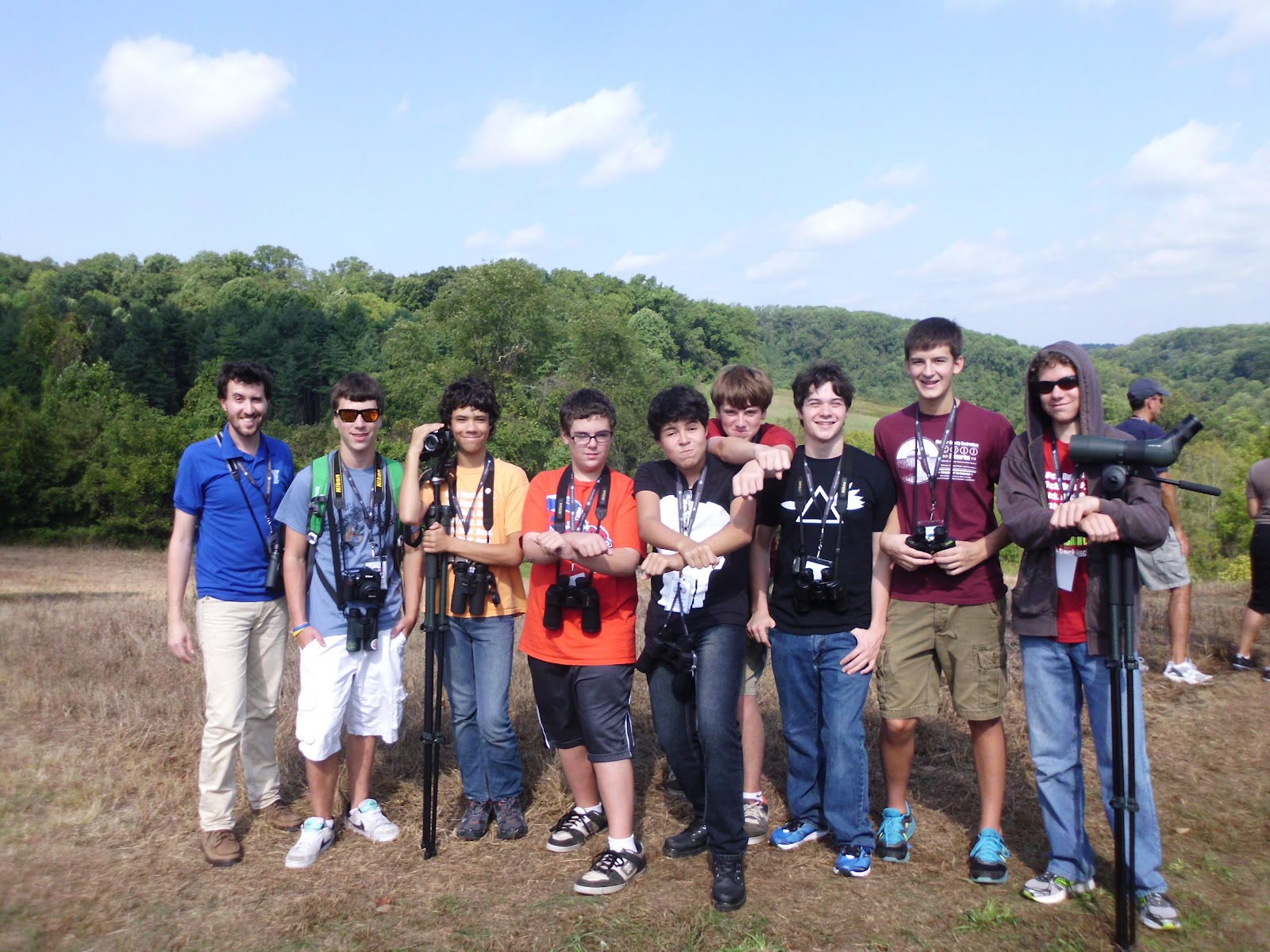
YESC takes a break from identifying birds of prey to strike a pose!
After our morning at the Hawk Watch, we were treated to additional presentations and a speech from the 2012 ABA Young Birder of the Year, Marie McGhee. Marie recapped the highlights of her past birding year reflecting upon challenges of identification and the importance of field notes as a growing birder. An inspiring speech that motivated both participants and staff here at YESC!
We then enjoyed a lunch at the Hawk Watch (since we are able to bird while eating) before returning for additional sessions.

YESC members Ben Bussmann and Alex Heerding observe the study skins of birds of prey during "Do You Geek Hawks?" by Dr. Jean Woods
To close out the day, ABA President Jeff Gordon gave a rousing introduction to the conference's keynote speaker, the editor of Bird Watcher's Digest, Bill Thompson III. In addition to some wise words, Bill treated the audience to an excellent musical performance.

American Birding Association President Jeff Gordon

Bill Thompson III reminds us to not let our babies grow up to be cowbirds!
Overall, the American Birding Association Mid-Atlantic Young Birder Conference was a great success! Over one-hundred forty people came and participated in the event. I want to send a special thank you to Bill Stewart, Jeff Gordon, and everyone at the American Birding Association who worked tirelessly to create such an inspiring and wonderful event!

YESC members posing with Bill Thompson III
Until next time, bird up and get involved!
- BQ
Wednesday, August 15, 2012
YESC Canoe Adventure 2012
Hey gang,
On August 7th, 2012, YESC embarked on our very first canoe camping trip on the Susquehanna River in beautiful central Pennsylvania! The YMCA Earth Service Corps of Discovery II consisted of Alex, Kirsten, Emily, Yusuf, Harrison, Austin, Zach, Annalie, and myself over a physically strenuous four day, three night paddling experience of a lifetime.


On August 7th, 2012, YESC embarked on our very first canoe camping trip on the Susquehanna River in beautiful central Pennsylvania! The YMCA Earth Service Corps of Discovery II consisted of Alex, Kirsten, Emily, Yusuf, Harrison, Austin, Zach, Annalie, and myself over a physically strenuous four day, three night paddling experience of a lifetime.

The gear loaded up on the first day! We had to bring all of our food, water, and personal gear with us in our canoes.

Some serious guys out on the water!

Every night we stayed on a different island in the Susquehanna River Trail System. Our first day was an eight mile paddle, and this was our first campsite location on Campsite Island 112. You can see master chefs Alex and Emily making our dinner: beans, cheese, Spanish rice, and chips. Spectacular!

Master navigator Kirsten on day two! Our second campsite was more difficult to find than the first, which made our arrival that much sweeter. After a ten and a half mile paddle, we were very excited to arrive until we realized our campsite was pretty overgrown.

As you can see, quite overgrown! A mix of Japanese Knotweed and Poison Ivy (yikes!) When we arrived, we had to clear space for our tents and gear to fit on the site. We then enjoyed a delicious dinner of mac & cheese and mashed potatoes.

A little post-dinner YMCA from Yusuf, Alex, Kirsten, and Zach!
The third day of our adventure was by far the toughest. We paddled twelve miles, which was our longest distance for the trip in one day. Also, we were paddling against the wind and made our paddle that much more difficult. We arrived at our third and final campsite for the trip, and my camera ran out of battery! No electricity to charge our devices while on the trip.
On the third night, we enjoyed a delicious dinner of lasagna and biscuits made on the fire! At the conclusion of dinner, dark clouds began to loom on the horizon, and we went into waterproof mode: All personal gear was placed in tents, dry bags were sealed and secured, community gear was properly stored, canoes were tied together and then to a strong tree, and we patiently waited for the storm over some smores on the fire. As we patiently waited for the storm to arrive, I checked the weather map on my phone. The map showed a strong band of storms approaching, bringing with it strong lightning, pea-sized hail, and 20mph winds! After thirty minutes of waiting, the storm never arrived. However, as we looked to our east, we observed an incredible sight over the mountain range. The storm was passing and just missed us! We were treated to the most incredible display of lights as we observed the passing storm from a safe distance. For almost an hour, we sat together and enjoyed this incredible spectacle. What a way to spend the final night of our journey together!
Although storms did arrive around 4:45am that morning, it did not stop us from hitting the water and heading home. After bailing the water out of the canoes, we endured the rain as we paddled down the mighty Susquehanna. Below is a video taken on my phone from our final journey:
The final rapids, known as the Dauphin Narrows, were the sign that we knew we were close to our exit. Conveniently, the narrows were also the most treacherous rapids we encountered!
The final rapids, known as the Dauphin Narrows, were the sign that we knew we were close to our exit. Conveniently, the narrows were also the most treacherous rapids we encountered!

We encountered this popular landmark in the Dauphin Narrows. A replica of the Statue of Liberty! You can oftentimes see this statue from Route 322 when traveling to and from State College.

We made it through the narrows!

One final group photo with the Statue of Liberty in the background!
After we passed through the narrows, we arrived at the exit for the trip. We unloaded our gear and canoes as we celebrated the completion of this incredible trip!
During our journey, we saw 36 species of birds. The highlights included bald eagle (incredibly high numbers,) caspian tern, common loon, a flock of 32 common mergansers, wood duck, great blue heron, great egret, and black-crowned night heron!
The trip was nothing short of spectacular! The teamwork and leadership skills presented by YESC participants was truly remarkable, and I am very proud of everyone who did such a fantastic job on the trip. As I said before, when the going got tough, YESC got going!
I think the photo of Harrison appropriately represents how we all felt after the trip:

The trip was nothing short of spectacular! The teamwork and leadership skills presented by YESC participants was truly remarkable, and I am very proud of everyone who did such a fantastic job on the trip. As I said before, when the going got tough, YESC got going!
I think the photo of Harrison appropriately represents how we all felt after the trip:

Victory!!!
The YMCA Earth Service Corps of Discovery II was a great success! Looking forward to next year's adventure!
- BQ
Subscribe to:
Posts (Atom)